Leadership in the AI Era: Stewarding Human Capital Through the AI Transition

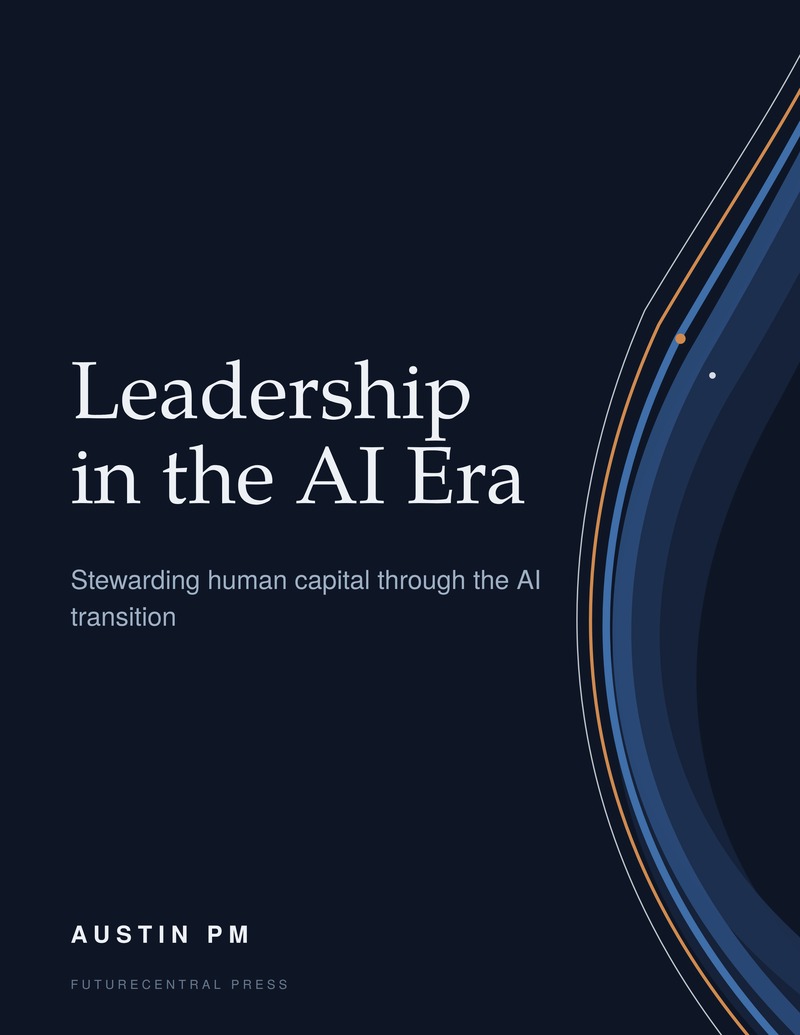
Leadership in the AI Era book cover
AI, Strategy & Leadership · MBA / Postgraduate

Leadership in the AI Era

Stewarding Human Capital Through the AI Transition

Austin PM · FutureCentral Press

Examine what AI changes about leadership, and how to preserve judgment, motivation and the development of human capability through the transition.

Completed manuscript19 chaptersCases and leadership exercises
EditionFirst edition · 2026
Structure19 chapters · 6 parts · 3 appendices
AudienceMBA learners and leaders

Stewarding human capability through the AI transition

This book examines the leader’s own judgment, the experience of people working with AI, and the organization’s capacity to develop talent. Machine advice and hybrid teams lead into motivation, trust, apprenticeship, reskilling, culture and accountability.

Cases, leadership frameworks and applied exercises ask readers to make specific decisions about how people learn, work and take responsibility as AI changes the tasks around them.

What readers will learn

  • Examine how AI changes leadership and the exercise of judgment.
  • Design decisions and verification practices around machine advice.
  • Lead hybrid teams with clear roles, responsibility and trust.
  • Rebuild apprenticeship, reskilling and talent pathways.
  • Assess motivation, culture and the human costs of transformation.
  • Define board and executive accountability for AI-era leadership.

Leadership arguments become practical work

Each chapter combines analysis with an applied exercise and reflection questions. The work asks readers to name a real leadership problem, make a design choice and examine what that choice preserves or puts at risk.

Read before you decide

Explore the book and its leadership exercises

Read a representative chapter, then try its guided leadership exercise online.

Book sample · Chapter 12

The Broken Apprenticeship Ladder

Rebuilding the Path to Senior Judgment When the Bottom Rungs Automate

The complete chapter, including the Ladder-Rebuild Model, a practitioner perspective, an applied exercise, reflection questions and references.

Read sample chapter →
Practical work sample

Leadership Exercise Sample

Leadership in the AI Era: Stewarding Human Capital Through the AI Transition

Build a judgment-map for an entry-level role and design one deliberate learning substitute, with proximity and assessment built into the plan.

Read leadership exercise →
A framework from Chapter 12

Frameworks from the book

The Ladder-Rebuild Model

The Ladder-Rebuild Model is this chapter’s principal framework, and it rebuilds the apprenticeship as a deliberate design, since the osmosis that once did the work has ended. It works in four movements, applied to each entry-level role whose work is automating. Name the judgment the old work built; design a deliberate substitute that builds the same judgment without the automated repetition; sequence and assess the substitute so that it actually forms the capability; and keep the learner in proximity to the judgment being exercised.

The first movement names the specific judgment the automated work used to build. Diagnosis: name precisely what judgment the now-automated work actually built. The document review built pattern recognition for dangerous clauses; the model-building built a feel for when a number is wrong; the reconciliation built an instinct for where errors hide. This diagnosis is harder than it looks, because the judgment was never made explicit while the work built it incidentally, and naming it requires a senior person to articulate what they know that the junior grind taught them, which they have often never had to put into words.

The second movement designs deliberate practice that builds the same judgment differently. Substitution: design a practice that builds the same judgment without the volume of automatable repetition. If the old learning came from reviewing 10,000 contracts, the substitute might be critiquing the machine’s review of curated hard cases, being handed the exceptions the machine flags as uncertain, or working through a designed sequence of instructive examples chosen for what they teach, with the week’s business needs set aside. The substitute deliberately supplies the judgment-building exposure that the automated workflow no longer provides as a byproduct.

The third movement sequences and assesses the substitutes so judgment actually forms. Sequencing and assessment is what turns a good intention into a working ladder. The substitutes have to be staged so that judgment builds in a sensible order, and assessed so that the organization can see whether the capability is actually forming, because a training substitute that no one checks degrades into a ritual as empty as the hazing the chapter warned against. The model describes a standing ladder, and treating it as a course to be delivered once forfeits it, because the judgment it builds is the organization’s future capability and requires the same standing attention as any other asset the organization depends on.

A fourth movement, easy to omit and fatal to omit. Proximity: keep the learner in the room where the judgment is exercised. The first three movements can all be satisfied on paper by a training program, and the old apprenticeship was never a training program. What transmitted was overheard reasoning, the partner thinking aloud about why this clause was the dangerous one, and none of the substitutes reproduce it if the junior is not present when it happens. Designing the practice and then delivering it at a distance rebuilds the syllabus and loses the thing the syllabus was standing in for.

Where the model misleads. Its diagnosis step assumes the automated work built one identifiable judgment, and much entry-level work built several at once, unevenly, in ways the people who did it cannot articulate on request. A leader who runs the diagnosis honestly should expect to end up with a partial list, and should design for the gap it leaves. The model also cannot tell a leader whether the judgment in question is still worth building. Some of what the old ladder transmitted was genuinely specific to work that no longer exists, and rebuilding it faithfully would be an expensive way to train people for a firm that is gone.

Read Chapter 12 for the worked application →

Table of contents

View all 19 chapters and appendices

Part I: The Second Great Transition

  1. Leadership at the Threshold
    Why This Time Rhymes but Doesn’t Repeat
  2. What AI Changes About Leadership Itself
    Why the Manager Automates and the Leader Concentrates

Part II: The Leader’s Own Craft

  1. From Having Judgment to Orchestrating It
    Judgment When the Machine Decides in Seconds
  2. Seeing Around Corners
    Foresight When the Machine Extrapolates the Past
  3. The Leader as Entrepreneur
    Reimagining the Business Model
  4. Deciding in the Age of Machine Advice
    Calibrated Trust When the Machine Is Fast, Fluent, and Sometimes Wrong
  5. Trust, Verification, and Epistemic Hygiene
    Re-earning Trust When the Machine Is Fluent, Confident, and Sometimes Fabricating

Part III: Leading People

  1. Motivation and Meaning When the Machine Does the Work
    Re-sourcing Purpose, Mastery, and Contribution After the Task Is Automated
  2. Leading the Hybrid Team
    Humans and Agents Side by Side
  3. Fear, Safety, and Change in the AI Workplace
    Holding People Through Real Fear With Hard Truth and Warm Delivery

Part IV: Building Human Capital

  1. The Future of Work
    Jobs, Work, and Ownership in the AI Era
  2. The Broken Apprenticeship Ladder
    Rebuilding the Path to Senior Judgment When the Bottom Rungs Automate
  3. Reskilling and the Half-Life of Expertise
    Continuous Reskilling as a Standing Commitment Against a Moving Curve
  4. Talent Architecture
    Hiring, Roles, and Careers in the AI Organization
  5. Culture as Human Capital
    The Norms That Govern a Human-Plus-Machine Workforce

Part V: Governance and the Organization

  1. Accountability and the Moral Load of AI-Era Leadership
    Answering for Outcomes You Did Not Foresee and Cannot Fully Control
  2. Leading Transformation You Don’t Fully Control
    Carrying People Through Change That Has No Finish Line
  3. The Board, the C-Suite, and the New Leadership Mandate
    From the Risk Register to the Leadership Mandate

Part VI: Synthesis

  1. The Threshold-Walker
    Leadership as Guiding People Across Eras

Appendices

Appendix A: Documented Cases of AI-Era Leadership

Appendix B: Frameworks of AI-Era Leadership

Appendix C: Glossary of AI-Era Leadership

Learning and teaching support

Teaching and study resources

Applied leadership exercises

Exercises ask readers to translate the chapter’s argument into a decision or design for their own organization.

Reflection questions

Chapter questions support discussion of the choices, assumptions and limits in the analysis.

Documented leadership cases

Appendix A brings together the book’s documented cases of AI-era leadership.

Frameworks of the book

Appendix B collects the leadership frameworks, including the Ladder-Rebuild Model.

Glossary and further reading

Appendix C provides the glossary; the chapters include references and further reading.

Academic evaluation

Faculty can request an inspection copy and enquire about available materials for a course or executive programme.

How resource access works

Public evaluation: read the chapter, leadership exercise and framework example online.

Purchaser resources: resource packages and downloadable access will be confirmed when sales open. Purchaser access is not yet active.

Faculty resources: ask the Press about inspection copies and currently available teaching materials. Restricted resources require faculty verification.

Academic inspection and resource enquiries

Considering this book for a course? Request an inspection copy or ask about student and faculty resources. Include your institution, role and intended teaching use.

    Book: Leadership in the AI Era: Stewarding Human Capital Through the AI Transition

    Spam check: please answer the question below.

    Your details will be used to respond to this request. This does not subscribe you to a newsletter. Faculty access and inspection copies are reviewed individually. Privacy Policy.

    Continue exploring

    FutureCentral Briefings

    Follow ongoing developments across AI, business, and the specialist publications.

    Explore the briefings →

    Related books

    Explore related AI, strategy and leadership titles in the FutureCentral Press catalogue.

    Browse the catalogue →