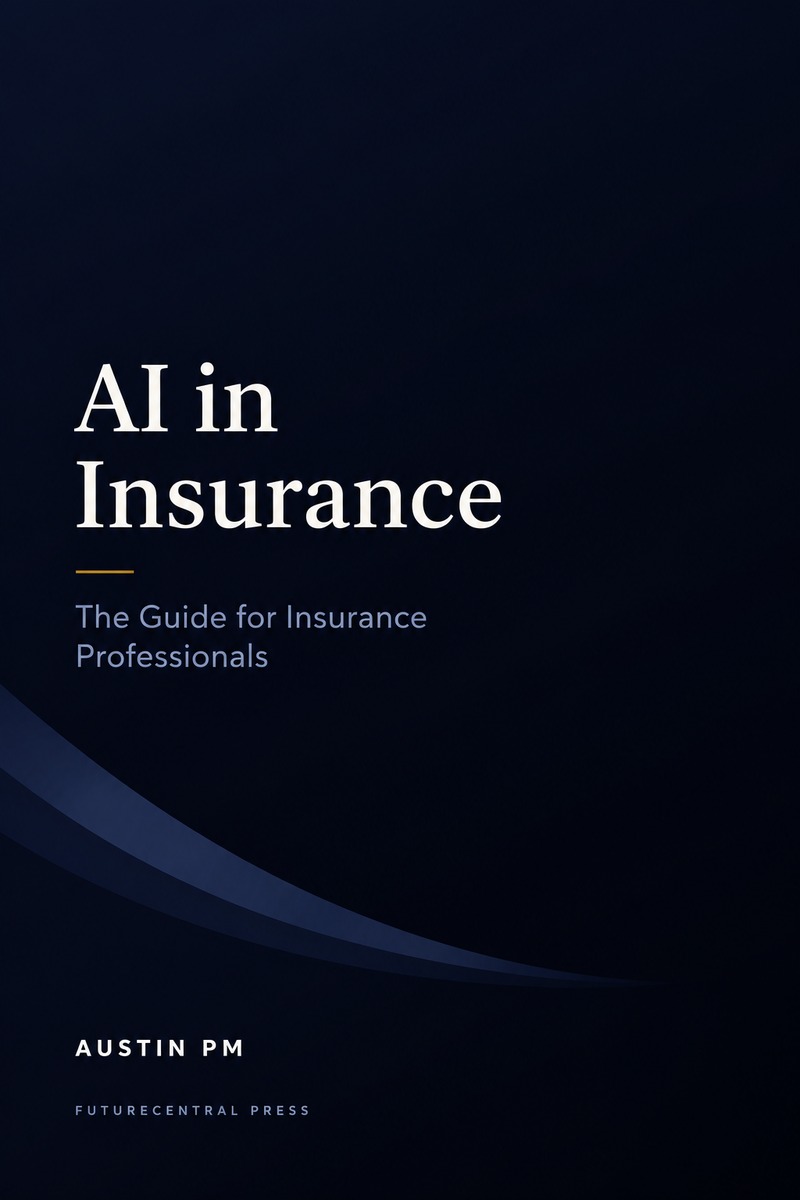
AI in Insurance: The Guide for Insurance Professionals book cover
Banking & Financial Services · Working Professionals

AI in Insurance

The Guide for Insurance Professionals

Austin PM · FutureCentral Press

Examine how predictive, generative and agentic AI change underwriting, pricing, claims, distribution and insurance operations. Connect technology choices with professional judgment, policyholder protection and the Indian insurance environment.

27 checked chapter manuscripts7 partsProfessional frameworks and exercises
EditionProfessional edition · in preparation
Structure27 chapters · 7 parts
AudienceInsurance professionals

Connect AI with the insurance professional’s work

The book examines life, health, motor, property, specialty, agricultural and reinsurance applications. Claims, actuarial modeling, fraud, distribution and operations chapters connect the technology with the insurer’s day-to-day decisions.

Generative and agentic AI sections lead into governance, regulation, cybersecurity and professional development. Frameworks, cases, practitioner vignettes and applied exercises help readers assess their own function and its priorities.

What readers will learn

  • Distinguish predictive models, generative tools and agents in insurance workflows.
  • Evaluate AI applications across insurance lines and reinsurance.
  • Assess underwriting, pricing, claims, fraud and distribution uses.
  • Map human judgment and customer protection across the claims journey.
  • Connect model risk, privacy, cybersecurity and governance with deployment choices.
  • Plan professional skills and priorities for the insurer’s next operating cycle.

Map the claims function’s AI capabilities

The selected chapter’s assignment audits four layers of the claims journey, from first notification to post-settlement recovery. Readers identify the highest-priority investment and their own role in the next review, producing a one-page Claims AI Stack Map.

Read before you decide

Explore the book and its claims operations exercises

Read a representative chapter, then examine its framework, applied audit and reflection questions online.

Book sample · Chapter 14

AI in Claims Operations: FNOL, Triage, Settlement, Subrogation

Digital claims intake, routing, image assessment, customer feedback and recovery.

Includes the Claims AI Stack, cases, a practitioner vignette, an applied exercise and 21 linked notes.

Read sample chapter →
Applied work sample

Claims Operations Exercise Sample

AI in Insurance: The Guide for Insurance Professionals

Read the four-layer framework, five-step claims audit and seven reflection questions.

Read claims exercise →
A framework and its working artifact from Chapter 14

Frameworks and decision tools from the book

The Claims AI Stack

Assess four layers: first notification and digital claims intake; triage, image assessment and qualifying settlements; customer-feedback analytics; and subrogation, recovery and readiness for agents.

The Claims AI Stack Map

Turn the four layer audits into a one-page map of the function’s capabilities and priorities. Identify the most important investment for the coming year and the role the working professional will take in the next review.

Read Chapter 14 for the framework and its application →

Table of contents

View all 27 chapters

Part I: Foundations

  1. The Rise of AI in Insurance
    Waves 1-3, how Indian insurance moved from paper-and-ink underwriting to AI-augmented operations, and what the underwriter, the actuary and the claims manager have to understand now
  2. Machine Learning and Deep Learning in Insurance
    Wave 3A: what predictive ML actually does inside the insurer, and what the underwriter, the actuary and the claims professional need to read off the model
  3. Data, Digital Signals, and the AI Infrastructure of Insurance
    Spans Waves 1–3: what data the insurer actually has, what data it can newly access, and what the underwriter, the actuary and the data professional have to read off the data fabric.
  4. The Strategic Logic of AI Adoption in Insurance
    Wave 3 (all sub-waves): build versus buy versus partner versus invest in InsurTech, and how the AI investment thesis differs by line of business

Part II: Core Insurance Use Cases

  1. AI in Life Insurance: Underwriting, Pricing, Persistency
    Wave 3A with 3B extensions: what AI actually does in mortality modeling, simplified-and-accelerated underwriting, persistency prediction, ULIP analytics, and the agent-and-bancassurance enablement that holds the architecture together
  2. AI in Health Insurance: Underwriting, Wellness, Claims, TPAs
    Wave 3A with 3B extensions: what AI actually does in health-risk scoring, wearables-and-wellness integration, hospital-network claims operations, TPA workflow automation, and the ABDM-and-PM-JAY infrastructure that holds the line together
  3. AI in Motor and Property Insurance: Telematics, IoT, FNOL
    Wave 3A with 3B extensions. What AI actually does in motor pricing, image-based damage assessment, FNOL-to-settlement compression, property and home insurance via satellite and IoT, and the fraud architecture that holds the lines together.
  4. AI in Commercial and Specialty Lines: Marine, Engineering, Liability, Cyber
    Wave 3A with 3B extensions: what AI actually does in marine cargo and hull, engineering and project insurance, liability lines (D&O, professional indemnity, product liability), cyber underwriting, and surety and trade credit; and why augmentation, not autonomous decisioning, is the right architectural posture for the working specialty underwriter
  5. AI in Agricultural and Crop Insurance: Parametric, Satellite, PMFBY
    Wave 3A with 3B extensions: what AI actually does in PMFBY at scale, parametric and weather-index design, satellite-driven NDVI yield assessment, livestock and aquaculture cover, and the IRDAI-NABARD-Ministry-of-Agriculture interface that defines Indian agricultural insurance
  6. AI in Reinsurance: Capacity, Treaty, NatCat, GIFT City
    Wave 3A with 3B extensions: what AI actually does in proportional and non-proportional treaty, facultative, retrocession, NatCat modeling, the GIC Re domestic role, the global reinsurance market, and the IFSCA-licensed GIFT City reinsurance hub
  7. AI in Insurance Operations: Policy Administration, Renewal, Servicing
    Wave 3A with 3B extensions. What AI actually does in policy issuance and endorsements, renewal optimization, customer service, complaint and grievance analytics, and the operations backbone where AI-driven productivity compounds.
  8. AI in Distribution: Agency, Broking, Bancassurance, Online Aggregators
    Wave 3A with 3B extensions: what AI actually does in agency lead generation and productivity, broker analytics, bancassurance partner management, online aggregator economics, embedded insurance, and the 2030 distribution build

Part III: Underwriting Risk, Claims, Fraud, And Operational Risk

  1. Actuarial Modeling, Reserving, and Capital in the AI Era
    Wave 3A. The chapter sets out what the AI overlay does for pricing actuarial work, IBNR and IBNER reserving, capital modelling, the IRDAI solvency margin and Risk-Based Capital roadmap, and the IFRS 17 transition, with the appointed actuary’s sign-off as the structural decision authority.
  2. AI in Claims Operations: FNOL, Triage, Settlement, Subrogation
    Wave 3A with 3C extensions. The chapter sets out what AI actually does across the end-to-end claims journey: image and video assessment, voice-of-customer analytics, automated triage, straight-through settlement for low-value claims, and subrogation and recovery analytics.
  3. Insurance Fraud Analytics
    Wave 3A with 3C extensions: what AI actually does in detecting staged accidents, exaggerated claims, ghost policies, organized motor-claim rings, health-claim collusion, identity fraud at onboarding, and how the layered architecture combines rules, supervised classifiers, graph-ML and image forensics on the IIB-and-PMLA architecture
  4. Operational Risk, Cybersecurity, and AI-Driven Threats in Insurance
    Wave 3 (all sub-waves): what AI actually does in operational-risk monitoring, cyber-threat detection, deepfake fraud in claims, and the IRDAI Information and Cyber Security Guidelines and CERT-In directions architecture

Part IV: Generative AI In Insurance

  1. What Generative AI Means for the Insurer
    Wave 3B: what large language models actually do, where they fit in the insurer’s workflow architecture, and what changes structurally for the underwriter, the actuary, the claims professional, the customer-service team and the wider operating architecture
  2. LLMs in the Insurance Workflow
    Wave 3B: what LLMs actually do across policy-document generation, claim-narrative drafting, customer correspondence, regulatory-reporting narrative, internal knowledge retrieval, and the agent-and-broker enablement layer that holds the architecture together
  3. Limits and Risks of Generative AI in Insurance
    Wave 3B: what hallucination, wrong-policy-recommendation, customer-facing-chatbot risk, the Air Canada precedent applied to insurers, the deepfake-claim manufactured-evidence problem, and model-output liability under IRDAI all mean for the working insurance professional

Part V: Agentic AI In Insurance

  1. From Insurance Assistants to Insurance Agents
    Wave 3C: what agentic AI actually does, the architectural shift from assistants to agents, the planning-and-tool-use-and-reflection loop, the human-in-the-loop control architecture, and what changes for the working underwriter, the claims professional and the broader operating architecture
  2. Agentic Workflows in Practice
    Wave 3C: what agentic deployment actually looks like at production scale across end-to-end onboarding, claims-from-FNOL-to-settlement, renewal and lapse-recovery, customer service, internal audit support, and agent and broker enablement

Part VI: Governance, Regulation, And The Indian Architecture

  1. Governance, Model Risk, and Responsible AI in Insurance
    Wave 3 (all sub-waves): what model-risk management, generative-AI validation, agentic controls and the responsible-AI architecture mean in working insurance terms, anchored on SR 11-7, IAIS, NAIC, the EU AI Act and the emerging Indian AI-governance expectations
  2. Regulation, Compliance, and the IRDAI Architecture
    Wave 3 (all sub-waves), the book’s regulatory anchor: IRDAI in full, Bima Sugam, Regulatory Sandbox, emerging AI-governance expectations, Information and Cyber Security Guidelines, IFSCA reinsurance regulations at GIFT City, and the joint architecture across RBI, SEBI, NABARD and the Ministry of Agriculture
  3. Cybersecurity, Privacy, and AI in Insurance
    Wave 3 (all sub-waves), what the DPDP Act applied to insurance, the IRDAI cybersecurity framework, the CERT-In directions and the AI-driven insurance-specific cyber-threat landscape mean for the working insurance professional

Part VII: The Insurance Professional And The Future

  1. The Role-by-Role Transformation
    Wave 3 (all sub-waves): what changes for the underwriter, the actuary, the claims manager, the surveyor, the broker, the agent, the bancassurance manager, the agricultural insurance officer, the reinsurance underwriter, the InsurTech product manager, the compliance officer and the technology partner over the 2026-2030 period
  2. Skills, Credentials, and the Career Architecture of the AI-First Insurer
    Wave 3 (all sub-waves): what insurance professionals must learn, how to learn it, what credentials matter (III, IFOA, SOA, CAS, IIRM, IAI), what the leadership track of the next decade requires, and how the cross-line career is being remade by AI
  3. The Future of the Indian Insurance Industry: Strategy and Transformation
    Spans Waves 1-3. The capstone: the 2030 Indian insurance industry, insurance penetration and density, IRDAI Vision 2047, the composite-license question, GIFT City reinsurance flows, the InsurTech-incumbent equilibrium, the agricultural-and-rural insurance imperative, and what it takes for India to become a global insurance hub
Student and faculty companions

Teaching and study resources

Explore the book’s exercises, frameworks and reference material. Ask the Press about current learning and teaching-resource availability.

Applied professional exercises

Assignments produce working audits and plans for insurance functions.

Frameworks and decision tools

Frameworks support the assessment of insurance workflows, controls and operating choices.

Executive Briefings

Briefings connect the chapter’s reasoning with conversations and decisions at work.

Reflection questions and cases

Professional questions, practitioner vignettes, and Indian and global cases support discussion and application.

Companion resources

Separate companion materials are not yet listed. Enquire about current availability before planning a training programme.

Professional and academic evaluation

Ask about inspection copies, organisational training use and available learning or teaching materials.

How resource access works

Public evaluation: read the sample chapter, claims exercise and framework examples online.

Purchaser resources: resource packages and downloadable access will be confirmed when sales open. Purchaser access is not yet active.

Faculty resources: ask the Press about inspection copies and currently available teaching materials. Restricted resources require faculty verification.

Academic inspection and resource enquiries

Considering this book for a course? Request an inspection copy or ask about student and faculty resources. Include your institution, role and intended teaching use.

    Book: AI in Insurance: The Guide for Insurance Professionals

    Spam check: please answer the question below.

    Your details will be used to respond to this request. This does not subscribe you to a newsletter. Faculty access and inspection copies are reviewed individually. Privacy Policy.